UNIGE/enviroSPACE

The enviroSPACE group is dedicated to spatial analyses within the Institute for Environmental Sciences, under both the Climatic Change and Climate Impacts group and the Forel Institute. The laboratory aims at promoting interdisciplinary research based on spatially explicit information and indicators on the present and future state of our changing and complex environment.
The project will essentially be implemented by:
- Dr. Anthony Lehmann Dr. Anthony Lehmann
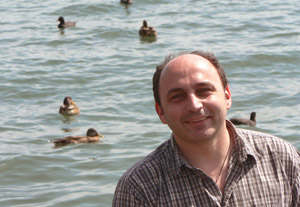 is the EnviroGRIDS project initiator and coordinator. He holds a Masters Degree and a PhD in Aquatic Biology from the University of Geneva, and a Postgraduate Master in Statistics from the University of Neuchâtel. He specialized during his career in combining GIS analyses with statistical models. At the University of Geneva he is in charge of the enviroSPACE laboratory exploring Spatial Predictions and Analyses in Complex Environments.
He is sharing is working time at a 50% rate with the United Nations Environment Programme (UNEP) Global Resource Information Database (GRID) under a special agreement between the University of Geneva and UNEP. At GRID, Dr. Lehmann is responsible for organizing research activities by leading the “environmental monitoring and modelling” unit. With the EnviroGRIDS project, his personal objective is to motivate all the partners to give their best in order to create a great observation system for the Black Sea Catchment. He will be specially involved in WP3 and WP5.
Personal page : https://www.unige.ch/climate/Team/Lehmann.html will insure the project coordination and the liaison with the GRID team. - Dr. Nicolas Ray Dr. Nicolas Ray
 is the enviroGRIDS project manager. He holds a Master in Environmental Sciences, a PhD in Biology from University of Geneva in the field of Human Population Genetics, and a postgraduate certificate in Computer Sciences. Nicolas’ research activities focused on the modeling of animal movement and habitat, with the development of several spatial and statistical analysis tools to integrate various data types (genetic, environmental, demographic). Through his research and various consultancy works, Nicolas acquired solid competencies in GIS, spatial analysis, software development, and grid computing integration. After six years of postdoctoral research in Australia, UK and University of Bern, he recently joined the Institute of Environmental Science at University of Geneva and UNEP/GRID-Europe to dedicate his time to the enviroGRIDS project.
In addition to managing the daily activities of the project and ensuring high quality deliverables, he will take an active part in WP2 with all tasks related to the integration of grid computing and SDI.
Personal webpage : https://www.unige.ch/climate/Team/Ray.html will ensure the project management and the liaison with administrative bodies at University of Geneva. - Dr. Stéphane Goyette will coordinate activities related to climate change
- Prof. Martin Beniston will coordinate activities related to climate change
- Dr. Douglas Cripe (M.Sc. in Atmospheric Science and Ph.D. in Physical Geography) is a Project Officer within the Group on Earth Observation Secretariat, working primarily on the administration of Tasks in the Water and Agriculture Societal Benefit Areas (SBAs), as well as the Data and Architecture Transverse Area.. He also occupies a position as senior scientists at the University within the C3i group.
Role in the project
UNIGE is coordinating the EnviroGRIDS project and leading WP1 and WP2. UNIGE is involved in many tasks and deliverables across the project in order to keep the best possible overview on the entire project. Its main tasks are however linked to the management of the project (WP1), the development of the grid-enabled spatial data infrastructure (WP2), remote sensing data integration (WP2), scenarios of demographic and climate change over the Black Sea Catchment (WP3), sustainability and vulnerability assessment of the BSC (WP5), and finally development of the after-life plan for EnviroGRIDS (WP7).